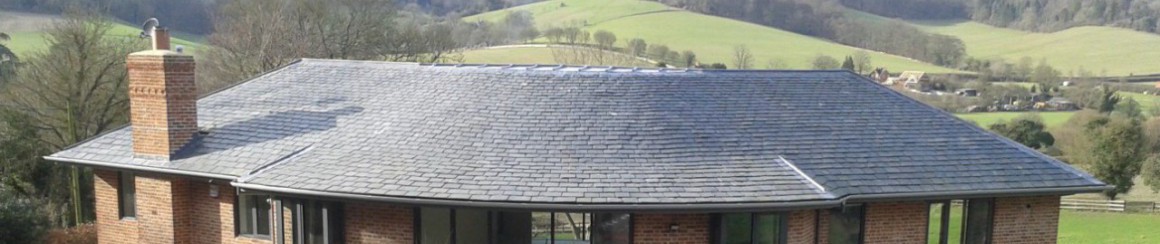
There may be trouble ahead.
Flat roofs.
When an older felt flat roof leaks it can be almost impossible to find the source, you may well see a wet or damp patch on a ceiling or wall below but the actual cause can be some distance away. The reason for this is that normally the first layer of felt is just tacked to the deck, the subsequent layers are fully bonded to that. If these layer get damaged or rot then when the water eventually finds it way through to the deck it can run between the tacked layer and the deck find it’s way in wherever it can. Unless you are lucky it means a new roof. We switched to single ply roofing some years ago and this was one of the reasons. Single ply, as the name suggests is just one layer, nowadays we use either Firestone EPDM rubber or a glass fibre system. Neither of these rot and the beauty of them is that even if you decided to have a party on your flat roof and someone managed to puncture it when dancing in their high heels, then both can be easily repaired, the roofs that is, not the heels.
Try to pre-empt any trouble, the tell tale signs that a felt roof needs replacing are:
- Splits to the felt and or the edge trims.
- Excessive pooling.
- Blisters in the felt.
Next time use a single ply, they just don’t give problems.
Pitched roofs
The most likely causes of water penetration can be found anywhere the roof either changes direction or meets an abutment:
Abutments (the bit where the roof tiles meet a wall or dormer etc )
- Behind the chimney there is usually a piece of lead formed to catch any water and take it out to the sides, this is known as a back gutter and is prone to developing splits, normally after many years. As a soft metal lead expands in the warm and contracts in the cold, give it long enough and a split will develop. If you have water staining at the back of the chimney in the loft, if there is one, then this is likely to be the back gutter. obviously this does not apply if the chimney straddles the ridge.
- If you have lead flashing to the sides of any abutment, these don’t normally give problems unless the “soakers” (angled pieces of zinc or aluminium) have failed. If you have a cement/tile fillet to the sides or front abutments these often crack away from the brickwork allowing water in.
- The following seems to be a recent phenomenon. Brick abutments, today are supposed to have a tray built in just above the flashing, In prolonged wet weather the brickwork can get so wet that it acts like a sponge sucking water behind any flashing and into either the cavity or the chimney, trays stop this. This does not apply to solid brickwork. We do not have an answer to this, all we recommend is that when the brickwork has totally dried, it is painted with a clear silicon based waterproofing paint
Box-gutters. These are at the bottom of a roof slope either where the roof meets a wall or an opposite slope.
- If lined with lead, there should be 50mm steps at most 1.5 metres apart. This allows for expansion and contraction and makes it last longer. Lead laid in longer lengths will develop creases and split. If you have a box gutter and it has a crease it is best to get it renewed before it splits. Box-gutters, being at the bottom of roof slopes, naturally carry the most water and when they fail they can cause a lot of damage.
Valleys, the bit between two roof slopes running bottom to top.
- If they are lead lined then the same warning signs as for box- gutters may be apparent, if it is creased or showing any signs of a split then replace it.
Hips and ridges.
- Even with ridge tiles missing these don’t let much water in. Do pay some attention to the mortar, if it’s missing or perished then strong wind could simply blow them away.
A couple of other things to look out for:
Slate roofs. Slates used to be fixed with iron nails, if you are having an increasing problem with slates slipping the chances are that the roof is suffering from “nail sickness” basically the nails have rusted away until they cannot hold the slates. The roof needs replacing, it won’t get any better.
Last one. We get called out to look at black mould on ceilings to find it is simply condensation, often after the insulation has been upgraded. If you upgrade the insulation in the loft you really need to ventilate the space, tile vents or soffit vents will do this. It is a good idea to fit an extractor in any bathroom at the same time.
How to choose a good Roofing Contractor.
Simple this:
Contact WRPS.
 WRPS Roofing Contractors 01844 238443